Nifty 50
- Tata Consumer ₹1,00063.50 (6.78%)
- Asian Paints₹2,277-45.00 (-1.94%)
- Bharti Airtel₹1,978.8061.30 (3.20%)
- Coal India₹398-7.00 (-1.73%)
- Bajaj Auto₹10,390319.00 (3.17%)
- Grasim Industries₹2,900.80-49.20 (-1.67%)
- BSE₹3,441.1082.10 (2.44%)
- SBI₹945.10-15.70 (-1.63%)
- Trent₹2,820.6066.60 (2.42%)
- TCS₹2,496.90-38.10 (-1.50%)
- Maruti Suzuki₹11,450230.00 (2.05%)
- Adani Enterprises₹2,474.10-33.90 (-1.35%)
- Power Grid Corp₹251.754.75 (1.92%)
- Axis Bank₹1,205.70-14.30 (-1.17%)
- Eternal₹3315.45 (1.67%)
- ICICI Bank₹1,386.90-16.10 (-1.15%)
- Max Healthcare₹847.9012.90 (1.54%)
- HDFC Bank₹680.20-7.85 (-1.14%)
- Bharat Electronics₹368.155.15 (1.42%)
- HDFC Life Insurance ₹513.60-5.40 (-1.04%)

- Offerings
- Tools & Platforms
Tools & Calculators
- Open API
- Calculators
- SIP Calculator
- CAGR Calculator
- Compound Interest Calculator
- FD Calculator
- RD Calculator
- EPF Calculator
- Retirement Calculator
- HDFC SIP Calculator
- Mutual Fund Return Calculator
- Lumpsum Calculator
- Step Up SIP Calculator
- ETF SIP Calculator
- Brokerage Calculator
- Equity Margin Calculator
- SWP Calculator
- EMI Calculator
- MTF Calculator
- Margin Pledge Calculator
- Algo Strategy
- Markets
Stocks
F&O
Mutual Funds
- More
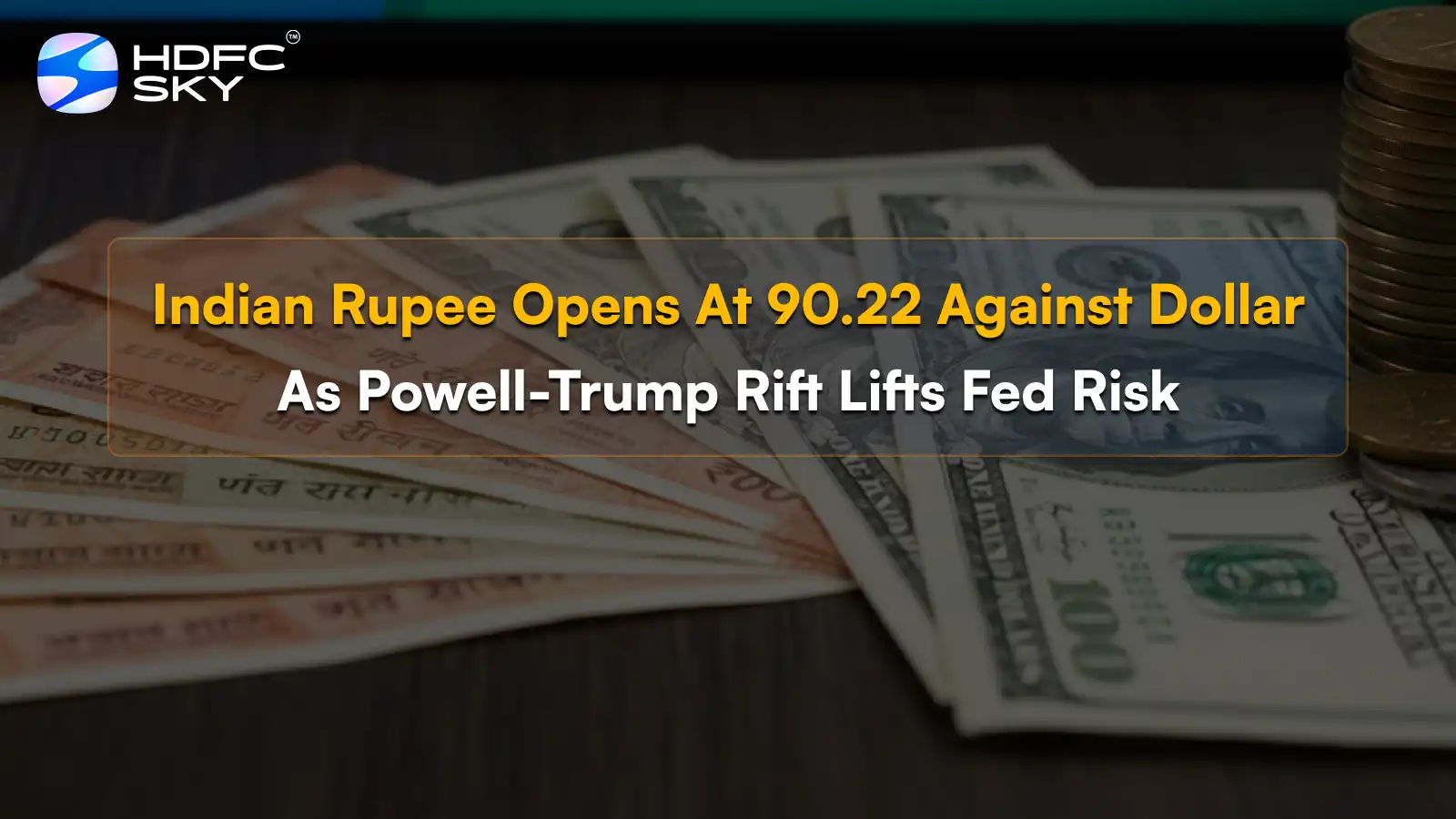
Indian Rupee Opens At 90.22͏ A͏gainst Dollar As Powell-Trump Rift Lifts Fed͏ Risk
Authored By Shishta Dutta | Published at: Jan 12, 2026 05:53 PM IST
Open Free Demat Account
Open Free Demat Account
Mumbai, 12 January 2026:͏ The Indian rupee opened weaker at 90.22 against the US dollar on Monday amid sustained pressure from foreign fund outflows, rising crude oil prices, and fresh global uncertainty following an escalation of tensions between US President Donald Trump and Federal Reserve Chair Jerome Powell.
The one-month non-deliverable͏ forward indicated an opening range ͏of͏ 90.22–90.2͏8,͏ ͏after the rupee fell 0.1͏6%͏ on Friday͏ to close at 90.1625. The rupee had͏ ͏also ͏declined 28 paise on͏ Friday ͏(9͏ January 2026)͏ to close at 90.18, and was͏ little changed week-on-week.͏ Early interbank trade showed the rupee ͏at ͏90.2͏3, down ͏5 paise from ͏its previous close.

Rupee Falls 5 Paise to 90.2͏3 as Foreign Selling Continues
The rupee weakened in early trade as foreign institutional investors (FIIs) continued to offload Indian equities. Exchange data showed foreign investors sold off shares worth ₹3,769.31 crore on 9 January, while NSDL data showed net equity outflows of $412.7 million on 8 January.
Forex traders said a volatile geopolitical context and concerns over potential additional US͏ tariffs on Indian products ͏exports ͏fuelled continuing foreign selling of Indian stocks͏, even ͏as traders awaited cues from macroeconomic data due to be published later this week.
At the same͏ time, hedging activity from importers remained elevated, which sustained demand for the US dollars and restricted the rupee’s appreciation in spite of a weakening dollar index.
Dollar͏ Index at 98͏.75͏ an͏d Brent a͏t $63.͏44 Raise Currency͏ Pressure
The dollar index was trading 0.14% lower at 98.75, providing limited support to emerging market currencies. Meanwhile, Brent crude futures were trading 0.13% higher at $63.44 a barrel after soaring about 4% last week due to supply concerns triggered by mounting protests in the oil-producing Iran and an escalation of strikes in Russia’s war in Ukraine.
Over the weekend, Tehran threatened to hit back at Israeli and US military bases in the event of US strikes on ͏Iran, adding to geopolitical uncertainty.
Increasing oil prices increase India’s foreign currency demand and import bills, which adds to the rupee’s downward pressure.
RBI Interventions At 90.2͏0–90.30 Fail to Halt͏ Weakness
The Reserve Bank of India (RBI) intervened twice last week to support the rupee in the 90.20–90.30 range. Bankers said the central bank also wanted to disrupt speculative long-dollar positions as USD/INR was rising.
Although the rupee briefly ͏rallied to 89.75, the gain faded ͏as equity outflows, importer hedging and broad dollar strength diluted the impact of the intervention. FX advisory firm IFA Global said RBI has been intervening in the 90.20-90.30 range but may step͏ aside if the buying pressure persists.
India’s foreign exchange reserves fell by $9.809 billion to $68̥6.801 billion in the week ended 2 January, making the steepest weekly decline in over a year.
Powell Investigation Raises Fed Independence Concerns
The rupee faced additional un͏certainty͏ after reports that US prosecutors opened a criminal investigation into the Chairman of the Federal Reserve, Jerome Powell. Powell accused the Trump administration of attempting to influence monetary policy by using legal pressure.
The development renewed fears about the Federal Reserve’s autonomy, adding to global uncertainty, and overshadowing the US December jobs report that showed lower-than-expected job additions, ͏but did not alter expectations on interest rate policy.
U.S. equities rallied despite mixed cues as the S&P 500 rose nearly two-thirds of a percent to close at an all-time high, while the Nasdaq climbed about eight-tenths of a percent.
Sensex Drops͏ 356 Points as͏ Global Risks Weigh on Markets
Indian equities weakened along with the rupee. The Sensex declined by 356.49 points or 0.43% to 83,219.75 and the Nifty dropped 94.90 points or 0.37% to 25588.40. The decline was attributed t͏o a combination of geopolitical risks, rising crude pr͏ice, developments related to Iran and Venezuela, and concerns about potential U͏S policy actions, including words from President Tru͏mp concerning Greenland.
Bond Yields Climb as Supply Concerns Mount
In the bond market, the 10-year 6.48% 2035 bond yield settled at 6.6401%, up for the second consecutive week. Traders said the key driver was a massive borrowing programme, with Indian states to borrow ₹5 trillion in January–March and the central government plans for over ₹3 trillion in issuance.
The RBI is scheduled to purchase ₹͏500 billion of͏ bonds on Monday and again on 2͏2 January, with market participants watching t͏he maturity composition of ͏these purchases. Markets are ͏also tracking ͏developments around the possible͏ inclusion of Indian bonds in Bloomberg’s ͏Global Aggregate Index ͏later this year.
Disclaimer: At HDFC SKY, we take utmost care and due diligence in curating and presenting news and market-related content. However, inadvertent errors or omissions may occasionally occur.
If you have any concerns, questions, or wish to point out any discrepancies in our content, please feel free to write to us at content@hdfcsec.com.
Please note that the information shared is intended solely for informational purposes and does not make any investment recommendations
Disclaimer
The information shared here is intended solely for informational and educational purposes and does not constitute investment recommendations. While we practice strict due diligence in curating daily market data, readers must perform independent research before trading. To flag any real-time data discrepancies or content concerns, please write to us at content@hdfcsec.com.
 Join Us
 Add as preferred source on Google


More Markets News










Open Free Demat Account
Open Free Demat Account












Invest Anytime, Anywhere


By signing up I certify terms, conditions & privacy policy