Nifty 50
- TCS₹2,34293.60 (4.16%)
- ICICI Bank₹1,422.80-20.20 (-1.40%)
- Tech Mahindra₹1,640.9055.90 (3.53%)
- Shriram Finance₹1,086.90-14.10 (-1.28%)
- Infosys₹1,14433.20 (2.99%)
- ITC₹266-3.00 (-1.12%)
- HCL Technologies₹1,316.1034.10 (2.66%)
- UltraTech Cement₹11,589-128.00 (-1.09%)
- Wipro₹180.954.55 (2.58%)
- Asian Paints₹2,608.70-22.30 (-0.85%)
- Bajaj Auto₹11,910190.00 (1.62%)
- SBI Life Insurance ₹1,761.10-12.10 (-0.68%)
- Hindalco Industries₹1,037.4013.40 (1.31%)
- Eicher Motors₹8,059-41.00 (-0.51%)
- HDFC Bank₹720.309.30 (1.31%)
- Maruti Suzuki₹13,376-64.00 (-0.48%)
- Tata Motors PV₹319.403.40 (1.08%)
- Bajaj Finserv₹2,002-9.00 (-0.45%)
- Grasim Industries₹3,29032.00 (0.98%)
- InterGlobe Aviation₹5,166-23.00 (-0.44%)

- Offerings
- Tools & Platforms
Tools & Calculators
- Open API
- Calculators
- SIP Calculator
- CAGR Calculator
- Compound Interest Calculator
- FD Calculator
- RD Calculator
- EPF Calculator
- Retirement Calculator
- HDFC SIP Calculator
- Mutual Fund Return Calculator
- Lumpsum Calculator
- Step Up SIP Calculator
- ETF SIP Calculator
- Brokerage Calculator
- Equity Margin Calculator
- SWP Calculator
- EMI Calculator
- MTF Calculator
- Margin Pledge Calculator
- Markets
Stocks
F&O
Mutual Funds
- More
India's Bold Push to Build a Global Data Centre Hub
Authored By Shishta Dutta | Last Modified: Oct 15, 2025 12:21 PM IST

Open Free Demat Account
Open Free Demat Account
India is preparing for a big digital push with a new plan that could transform its data infrastructure. The draft National Data Centre Policy 2025 suggests giving developers a 20-year tax holiday if they meet key milestones in capacity, energy efficiency, and job creation.
On top of that, the policy proposes input tax credit (ITC) on GST for capital assets such as construction materials, heating, ventilation, and air conditioning (HVAC) systems, cooling systems, and electrical equipment. This means lower upfront costs for companies building these centres.
The goal is clear: make India a more attractive hub for data centres, cloud services, and AI development at a time when the demand for storage and computing power is growing rapidly.

Data Centres at Present
A data center is a physical site where servers, storage devices, and networking gear are kept together to run IT systems.
Currently, they are no longer just warehouses of servers. They power everything digital, from streaming and mobile banking to AI queries and cloud storage. Governments rely on them for e-governance and security systems , while businesses depend on them to keep apps, banking, e-commerce, and digital workplaces running smoothly.
Globally, data centres are concentrated in hubs such as Northern Virginia, Silicon Valley, Dallas, Singapore, Hong Kong, and Tokyo. India’s presence is rising, with Mumbai, Chennai, and Hyderabad gaining traction, backed by government initiatives.
Our data centre market is already expanding at a fast pace:
- Growth Rate: Compound annual growth rate (CAGR) of 24% since 2019
- Capacity Addition: 795 MW expected by 2027, reaching 1,825 MW in total.
- Occupancy Levels: 75-80%, reflecting strong demand.
- Investments: Colliers India projects US$20-25 billion in investments over the next five to six years.
- Footprint Expansion: Physical capacity to rise more than threefold, from the current 15.9 million sq. ft. to nearly 55 million sq. ft. by 2030.
- City Leaders: Mumbai and Hyderabad alone are set to add 1,000-1,200 MW each by 2030.
This growth reflects the rising adoption of digital services, 5G rollout, AI applications, and cloud migration across industries. Coldwell Banker Richard Ellis (CBRE) notes that as India’s digital economy scales, the demand for next-generation infrastructure will only intensify, making policy execution all the more urgent.
The Draft National Data Centre Policy 2025
At the core of the new policy are fiscal and regulatory incentives designed to attract domestic and global investors.
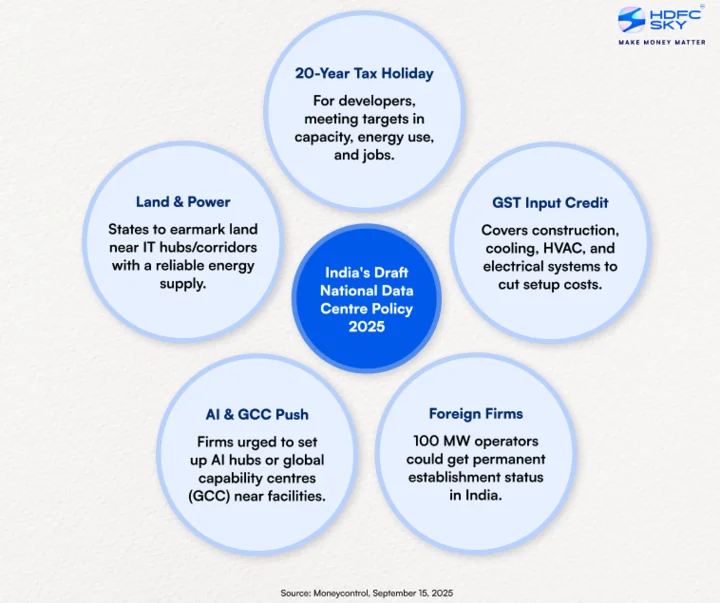
This policy framework seeks not only to reduce operational hurdles but also to align with India’s larger goals of job creation, renewable energy adoption, and AI advancement.
Tackling Land and Power Bottlenecks
Two of the biggest hurdles for India’s data centre expansion are land and power. The draft policy proposes that states earmark land near industrial corridors, IT hubs, and manufacturing clusters to build dedicated data centre parks. This would make land access more predictable and investor-friendly.
Power availability is even more critical. Since data centres demand an uninterrupted supply, the IT Ministry plans to coordinate with the Ministry of Power, the Central Electricity Authority, and the Central Transmission Utility of India. The draft also highlights green energy adoption, proposing uniform standards for energy storage and exploring the use of small modular reactors near large hubs, balancing cost competitiveness with sustainability goals.
Stocks and Industry Beneficiaries
The ripple effects of the policy will extend to allied industries. Companies that design, build, and power data centres are expected to gain. Three listed players stand out:
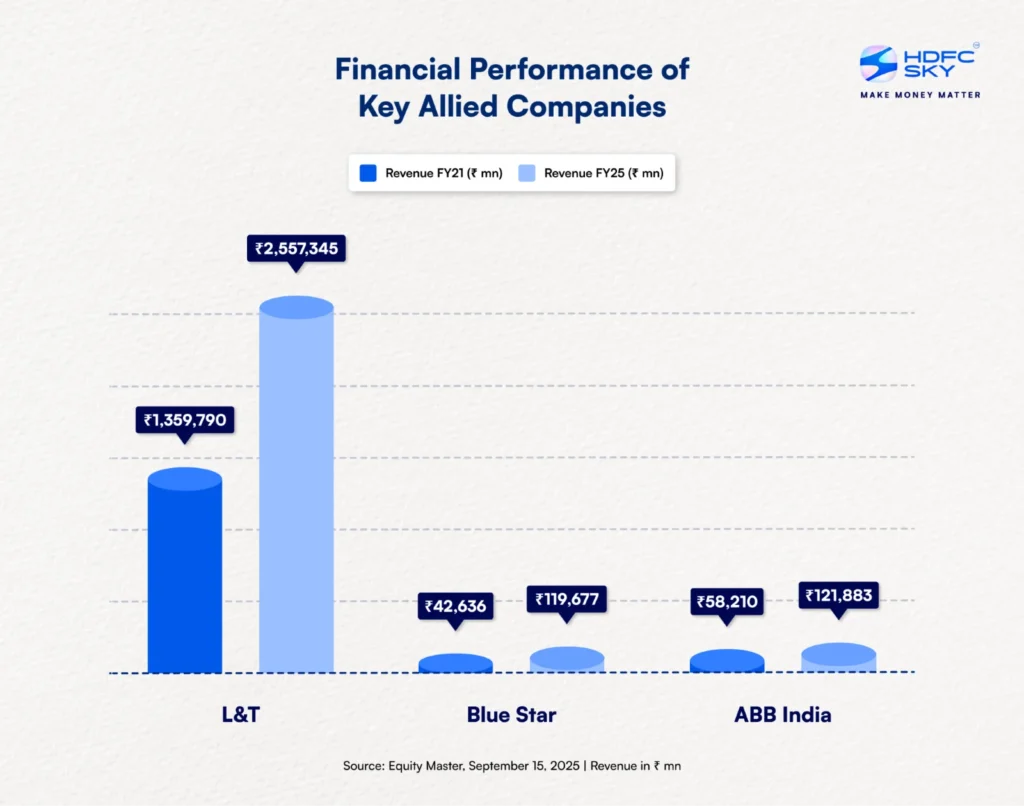
These companies are well-positioned to benefit from GST input credits and rising demand for infrastructure equipment, cooling systems, and energy management.
Policy Stability: The Real Key
Although incentives and tax breaks make India more appealing, long-term success depends heavily on regulatory stability. Capital-intensive projects with horizons of 15-20 years need predictable rules throughout. Investors worry that mid-term changes in taxes or compliance could undo initial gains.
India’s draft National Data Centre Policy, therefore, emphasizes balancing flexibility with credibility. The government has improved its regulatory and tax framework, yet credibility must match reforms. Without a stable regulatory environment, even strong fiscal incentives will fail to draw global, billion-dollar commitments.
Conclusion
India’s draft National Data Centre Policy is a big move to build a strong digital backbone. With 20-year tax holidays, GST input credits, and incentives for AI and cloud hubs, it tackles key barriers while targeting growth in capacity, efficiency, and jobs. The sector is already growing at a 24% CAGR with US$20-25 billion in expected investments.
But success will also need stable rules, reliable infrastructure, skilled talent, and a clear green energy plan. If all aligns, India can become a global hub for data centres and next-gen tech.
Disclaimer: At HDFC SKY, we take utmost care and due diligence in curating and presenting news and market-related content. However, inadvertent errors or omissions may occasionally occur.
If you have any concerns, questions, or wish to point out any discrepancies in our content, please feel free to write to us at content@hdfcsec.com.
Please note that the information shared is intended solely for informational purposes and does not make any investment recommendations
 Join Us
 Add as preferred source on Google


More Business News










Open Free Demat Account
Open Free Demat Account







Invest Anytime, Anywhere


By signing up I certify terms, conditions & privacy policy