Nifty 50
- Tata Consumer ₹1,00063.50 (6.78%)
- Asian Paints₹2,277-45.00 (-1.94%)
- Bharti Airtel₹1,978.8061.30 (3.20%)
- Coal India₹398-7.00 (-1.73%)
- Bajaj Auto₹10,390319.00 (3.17%)
- Grasim Industries₹2,900.80-49.20 (-1.67%)
- BSE₹3,441.1082.10 (2.44%)
- SBI₹945.10-15.70 (-1.63%)
- Trent₹2,820.6066.60 (2.42%)
- TCS₹2,496.90-38.10 (-1.50%)
- Maruti Suzuki₹11,450230.00 (2.05%)
- Adani Enterprises₹2,474.10-33.90 (-1.35%)
- Power Grid Corp₹251.754.75 (1.92%)
- Axis Bank₹1,205.70-14.30 (-1.17%)
- Eternal₹3315.45 (1.67%)
- ICICI Bank₹1,386.90-16.10 (-1.15%)
- Max Healthcare₹847.9012.90 (1.54%)
- HDFC Bank₹680.20-7.85 (-1.14%)
- Bharat Electronics₹368.155.15 (1.42%)
- HDFC Life Insurance ₹513.60-5.40 (-1.04%)

- Offerings
- Tools & Platforms
Tools & Calculators
- Open API
- Calculators
- SIP Calculator
- CAGR Calculator
- Compound Interest Calculator
- FD Calculator
- RD Calculator
- EPF Calculator
- Retirement Calculator
- HDFC SIP Calculator
- Mutual Fund Return Calculator
- Lumpsum Calculator
- Step Up SIP Calculator
- ETF SIP Calculator
- Brokerage Calculator
- Equity Margin Calculator
- SWP Calculator
- EMI Calculator
- MTF Calculator
- Margin Pledge Calculator
- Algo Strategy
- Markets
Stocks
F&O
Mutual Funds
- More
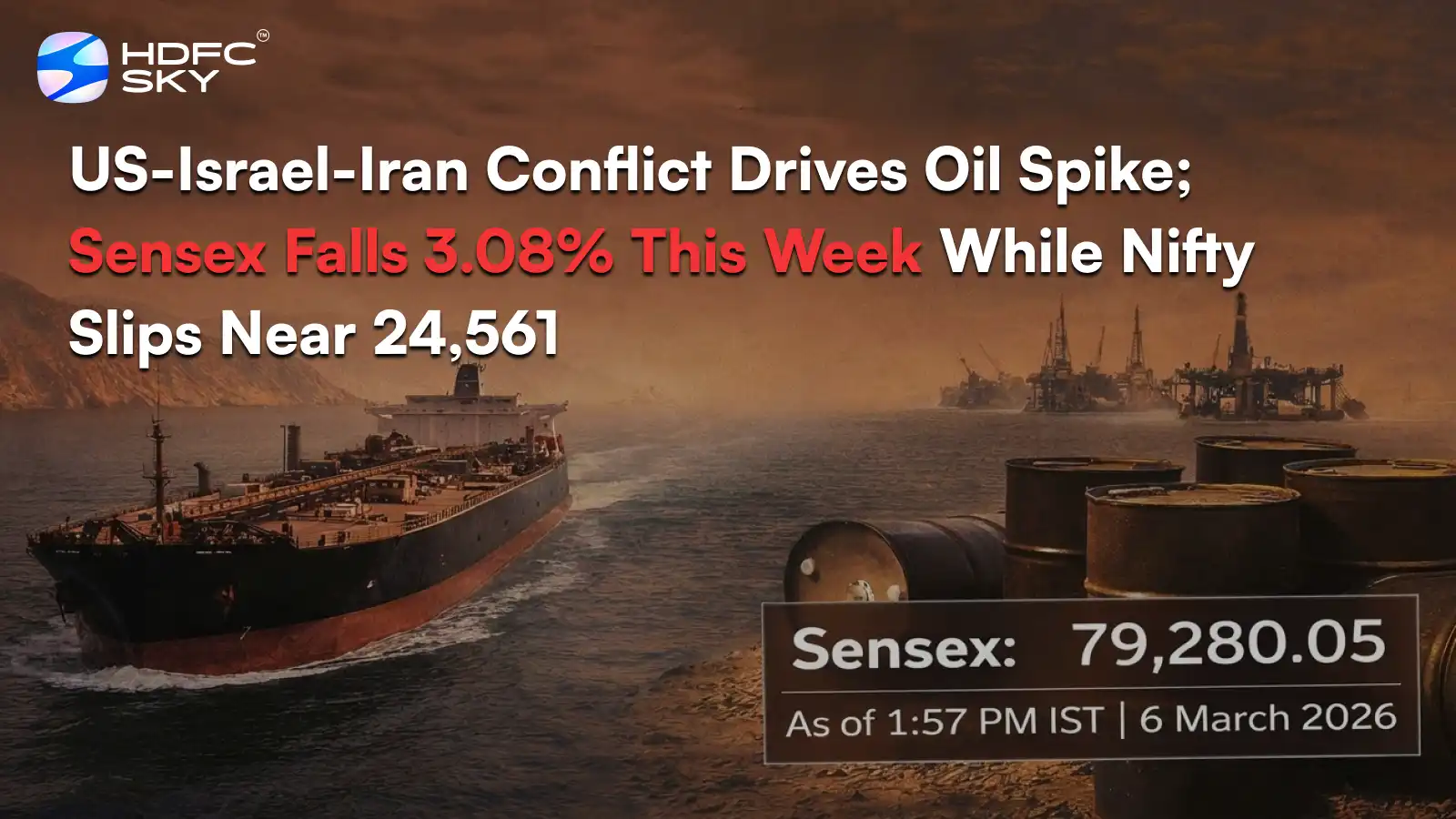
US-Israel-Iran Conflict Drives Oil Spike; Sensex Falls 3.08% This Week While Nifty Slips Near 24,561
Authored By HDFC SKY | Published at: Mar 6, 2026 04:12 PM IST
Open Free Demat Account
Open Free Demat Account
Mumbai, March 6: Escalating military tensions involving the United States, Israel and Iran triggered volatility across global commodity and financial markets on March 6, 2026, with Indian equities declining as crude oil prices surged sharply due to supply disruption concerns around the Strait of Hormuz.
Global crude benchmarks rallied strongly during the week after the outbreak of hostilities across West Asia. Brent crude traded near $84.46 per barrel while West Texas Intermediate hovered around $79.93 despite a minor intraday pullback, marking weekly gains of roughly 16–19%. The surge followed fears of tanker disruption across the Strait of Hormuz, a critical maritime corridor that carries roughly one-fifth of global oil supply.
Higher crude prices remain a direct macroeconomic risk for India, which imports more than 80% of its crude oil requirement. Rising energy costs typically pressure inflation expectations, widen the current account deficit and weaken investor sentiment toward emerging market equities.

Indian Stock Market Reaction
Indian benchmark indices declined as investors priced in geopolitical risk and higher energy costs.
The BSE Sensex stood at 79,280.05, down 2,518.33 points or 3.08% over the past five trading sessions, according to exchange data as of 1:57 pm IST on March 6, 2026. The index traded in a narrow intraday range with a session high near 79,753 and a low around 79,271.
The Nifty 50 was at 24,561.30 as of 1:58 pm IST on March 6, 2026, reflecting persistent selling pressure across sectors amid the ongoing conflict. Over the past month the benchmark index has declined about 1,132 points or 4.41%.
Market participants attribute the weakness primarily to elevated crude prices, foreign institutional investor outflows and global risk aversion triggered by the Middle East crisis.
Sectoral Impact Across Indian Markets
The rise in oil prices has uneven implications across sectors.
Aviation companies, oil marketing firms, logistics operators and paint manufacturers typically face margin pressure when crude prices climb sharply because fuel and petrochemical derivatives represent key input costs. If crude remains elevated, these industries may experience earnings compression.
Conversely, upstream oil producers and certain commodity-linked businesses may benefit from higher global energy prices. Safe-haven demand has also lifted precious metals, with gold futures on the Multi Commodity Exchange rising to ₹1,61,108 per 10 grams amid geopolitical uncertainty and a softer US dollar.
Financial markets also tend to experience higher volatility during geopolitical conflicts as investors rebalance portfolios toward defensive assets such as gold and government bonds.
Economic Context And Strategic Exposure
India’s exposure to West Asian geopolitics stems largely from its energy dependence and trade relationships with the region.
The Strait of Hormuz remains a strategic chokepoint for global oil shipments. Any prolonged disruption could significantly affect energy supply chains and increase freight and insurance costs for tanker traffic.
In addition, geopolitical uncertainty often triggers capital flows away from emerging markets into developed-market assets, creating short-term pressure on equity indices and local currencies.
Conclusion
The US–Israel–Iran conflict has emerged as a key external risk factor for Indian financial markets in early March 2026. Rising oil prices, safe-haven flows toward gold and global risk aversion have contributed to weakness in benchmark indices.
The near-term trajectory of Indian equities will depend largely on developments in West Asia and the direction of crude oil prices, both of which remain critical variables for inflation expectations, currency stability and investor sentiment.
Disclaimer
If you have any concerns, questions, or wish to point out any discrepancies in our content, please feel free to write to us at content@hdfcsec.com.
Please Note: The information shared is intended solely for informational purposes and does not make any investment recommendations
Disclaimer
The information shared here is intended solely for informational and educational purposes and does not constitute investment recommendations. While we practice strict due diligence in curating daily market data, readers must perform independent research before trading. To flag any real-time data discrepancies or content concerns, please write to us at content@hdfcsec.com.
 Join Us
 Add as preferred source on Google


More Markets News










Open Free Demat Account
Open Free Demat Account












Invest Anytime, Anywhere


By signing up I certify terms, conditions & privacy policy